Curtis Hale
06

SERVPRO

01

Business Context

National enterprise. Outdated front door.

What began as a small painting business over 50 years ago has grown into the national leader in cleaning and restoration — more than 1,900 franchise locations serving customers across the country, across 23 distinct service categories ranging from water and fire damage to mold remediation and general cleaning.

For a company of that scale, the website isn't a marketing asset. It's operational infrastructure.

Stage:

Mature enterprise — 1,900+ locations, decades of brand equity, complex franchise model requiring both national consistency and hyper-local utility

Market position:

Category leader in an industry where customer acquisition is largely crisis-driven. People don't browse SERVPRO casually — they arrive in an emergency, under stress, needing help immediately.

Brand maturity:

Established national brand with strong recognition — but a digital presence that had fallen behind both the scale of the business and the expectations of users in urgent need

SERVPRO
1,900
SERVPRO locations included
3
Separate teams in collaboration
23
Cleaning & restoration services featured on the site
02

The Alignment Problem

An enterprise with 1,900 locations and no coherent digital front door.

The existing site had been built for a different era of the business. As SERVPRO grew — more locations, more services, more franchise complexity — the website had accumulated rather than evolved. The result was a digital experience that worked against the people who needed it most.

The structural problems were significant:

23 service categories with no clear information hierarchy — users couldn't quickly determine what SERVPRO did or whether it applied to their situation

1,900 franchise locations with no intelligent local routing — national brand traffic wasn't connecting users to the right local team

Contact information buried in the experience — in an emergency use case, that's not a UX inconvenience, it's a business failure

No coherent design system — visual inconsistency across sections signaled a brand that hadn't kept pace with its own growth

Three separate teams — SERVPRO internal, an external agency partner, and a development team — operating without a unified creative framework or clear decision architecture

The alignment problem here was both user-facing and organizational. The site needed to solve for a high-stakes, crisis-driven user journey. And doing it required coordinating creative direction across three distinct teams with different functions, priorities, and workflows.

SERVPRO technician in protective suit disinfecting a sunlit loft interior
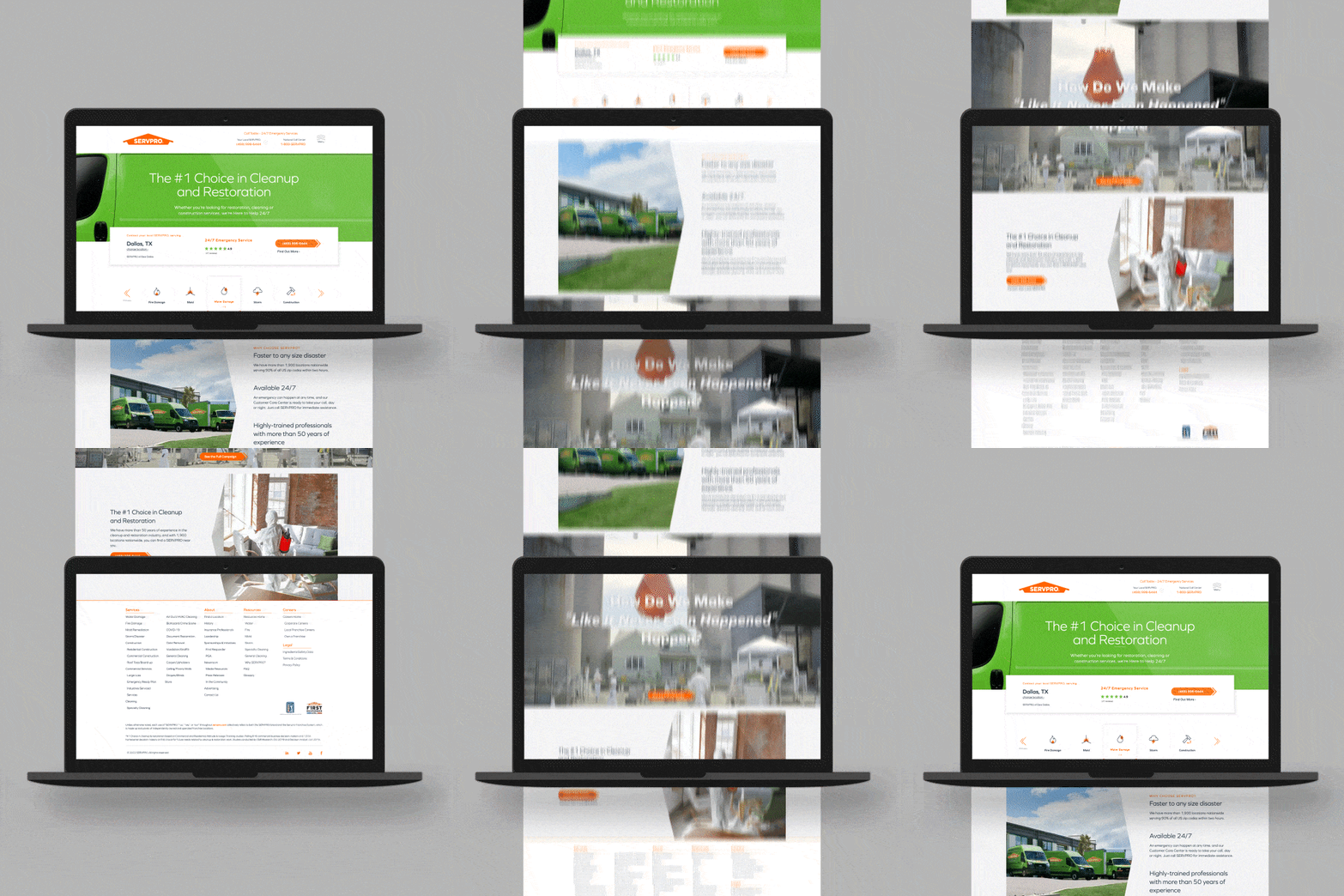
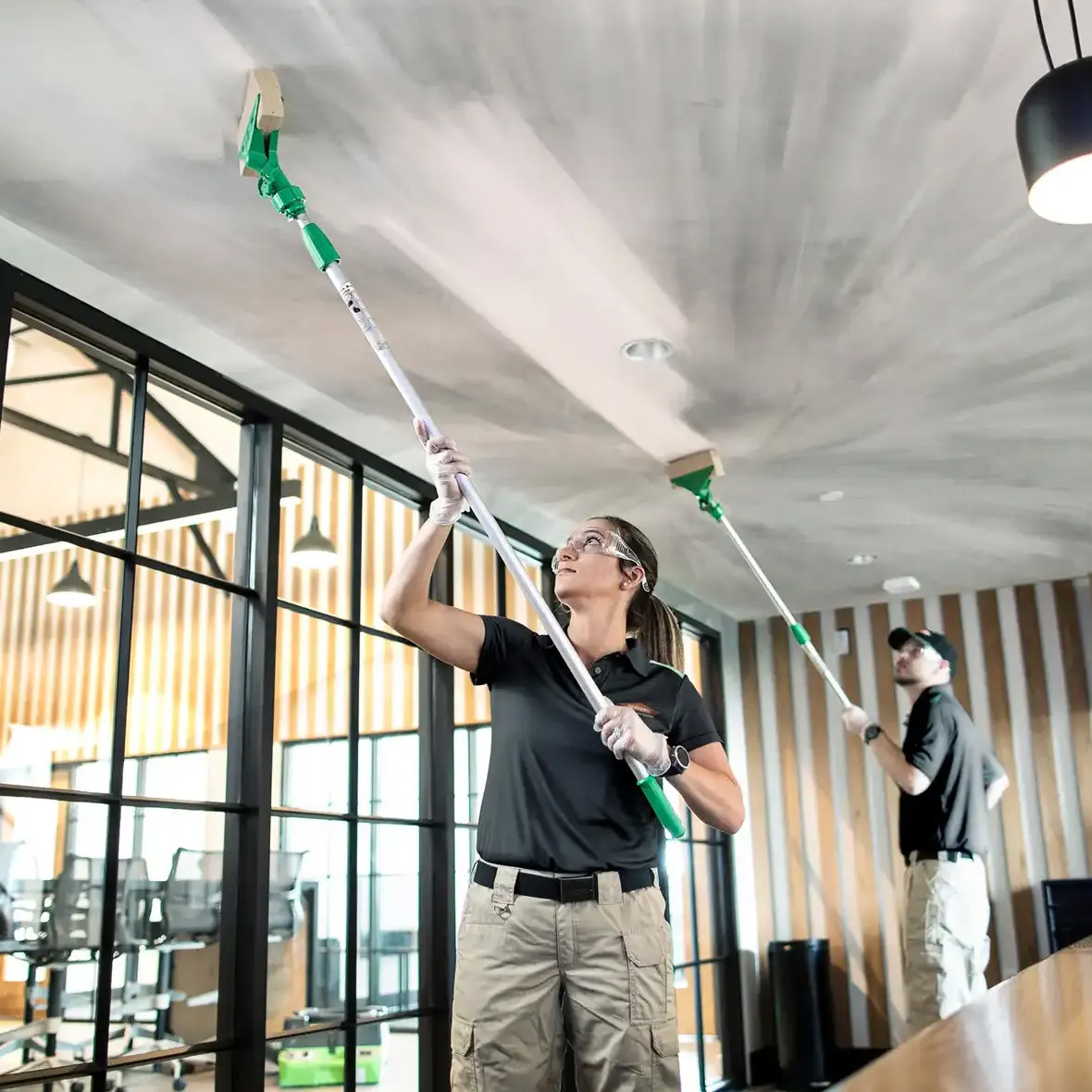
SERVPRO interface animationSERVPRO technicians cleaning a ceiling with extended tools
03

Strategic Framework

Design for the worst moment of someone's day.

The strategic insight that shaped every decision: SERVPRO's users are not browsing. They are in distress. A pipe has burst. There's smoke damage. Mold has been found behind the walls. The person arriving at SERVPRO.com has a problem that feels overwhelming, and they need to feel — immediately — that they've reached the right place and that help is close.

That single insight reframed the entire design brief. This wasn't a website redesign. It was a trust system for people in crisis.

Positioning decision The site needed to communicate two things in the first three seconds of arrival: we handle exactly your problem and your local team is right here. National credibility and local proximity had to coexist — and neither could be subordinated to the other.

Information architecture strategy With 23 services and 1,900 locations, the IA challenge was genuinely complex. The strategic decision was to build the navigation around user urgency rather than SERVPRO's internal service taxonomy. Users in a crisis don't think in category labels — they think in situations. The architecture was designed to match the way distressed users actually describe their problems, not the way SERVPRO organizes its operations internally.

Local trust as a UX problem The most consequential strategic decision was identifying local trust and emergency accessibility as the same problem. A national brand inspires general confidence. A local franchise phone number — displayed immediately, automatically matched to the user's location — closes the gap between "I trust this company" and "I'm calling right now." That reframe drove the technical architecture decision to implement IP-based location detection with ZIP code override, which in turn shaped the entire header and contact experience across the site.

Multi-team creative framework Before any design work began, I established a shared creative framework across all three teams — defining the UX principles that would govern decisions, the approval workflow that would prevent fragmentation, and the division of creative ownership between design strategy (my team), content architecture (agency partner), and technical execution (development). Without that alignment, three teams working simultaneously on an enterprise site would have produced three different products.

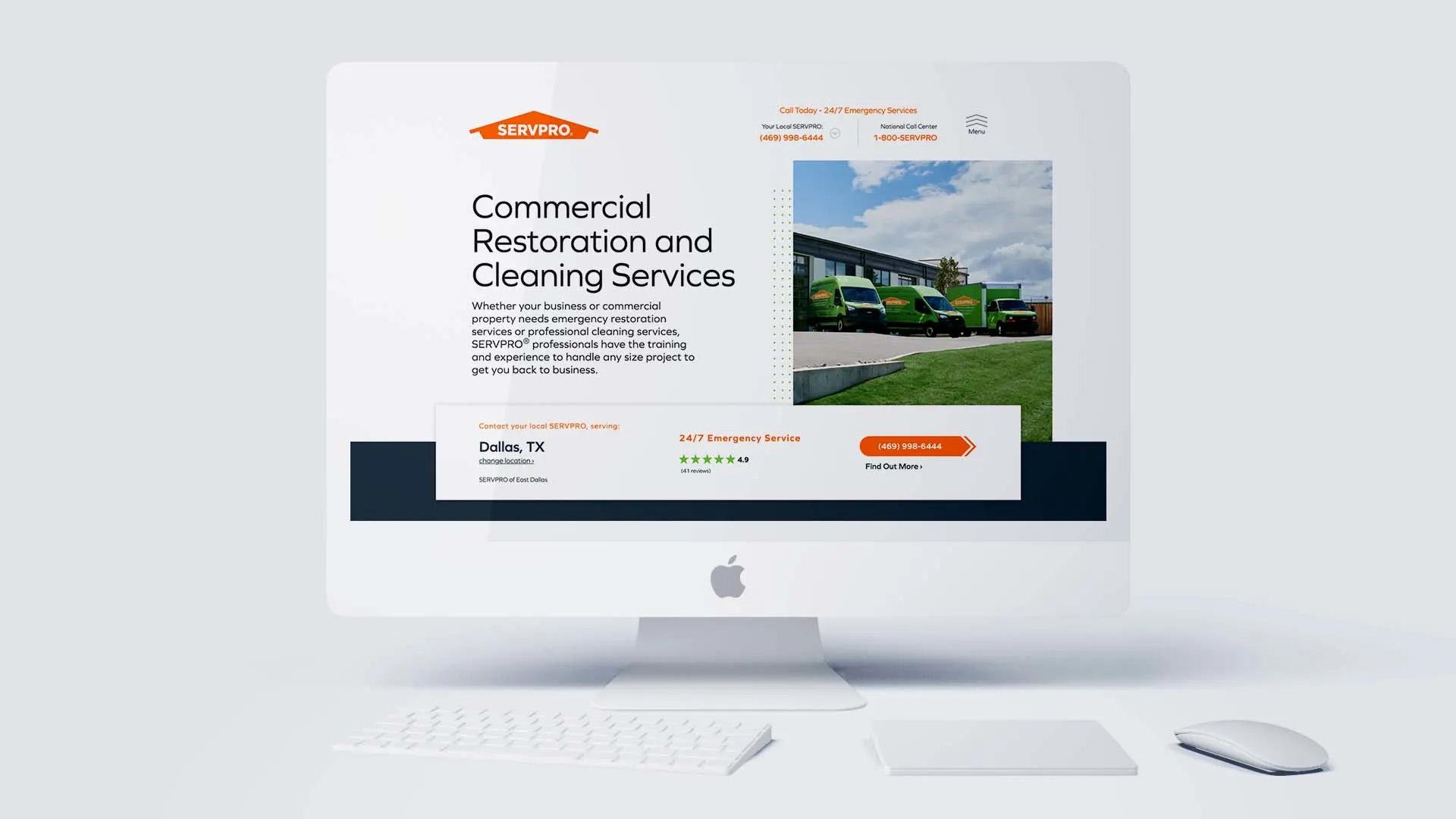
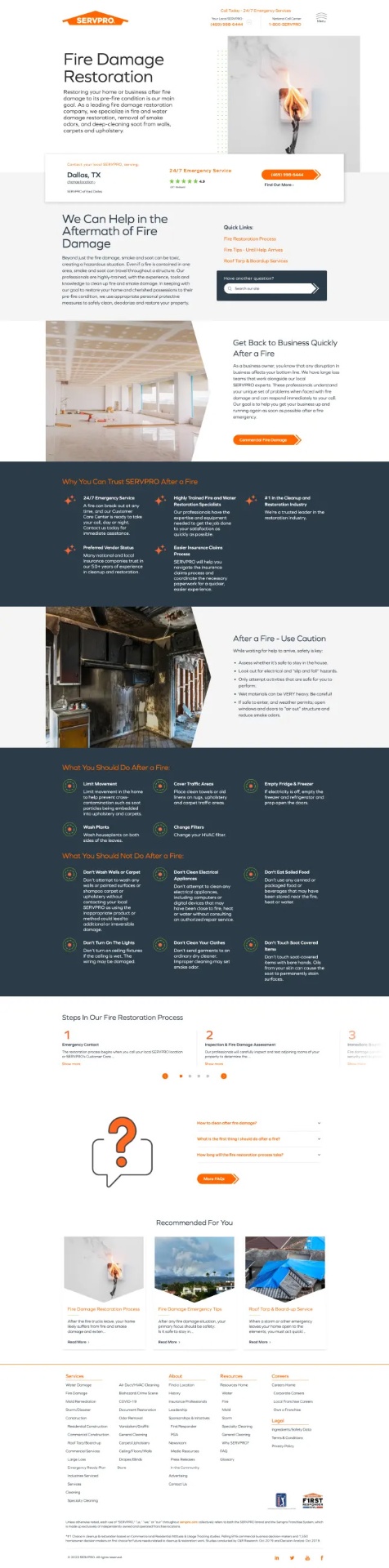
SERVPRO commercial and residential restoration services pageSERVPRO smoke and fire damage restoration page
04

Creative System

A design system built for scale, urgency, and franchise complexity.

High-fidelity wireframe prototype The engagement began with a full-site wireframe prototype — not low-fidelity sketches, but a high-fidelity interactive prototype that modeled the complete user journey before a single line of production code was written. This served two purposes: it aligned all three teams on the experience before the expensive work began, and it gave SERVPRO leadership a concrete artifact to approve rather than an abstract concept to imagine.

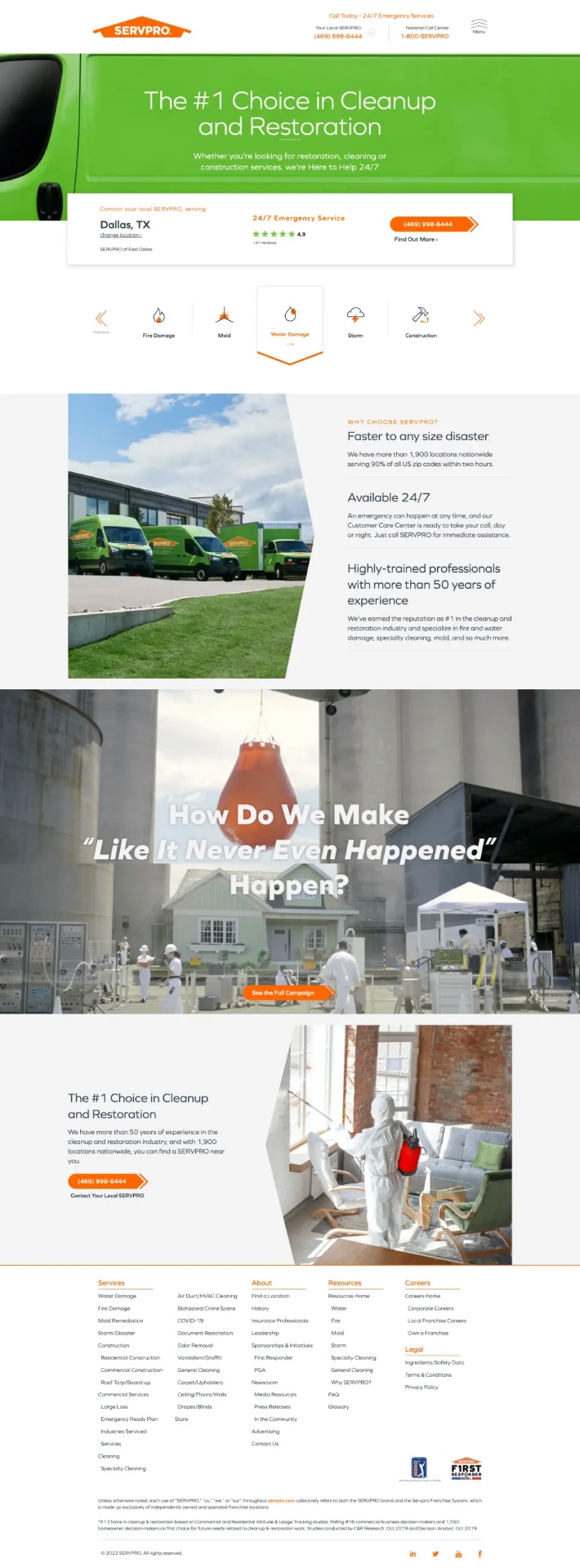
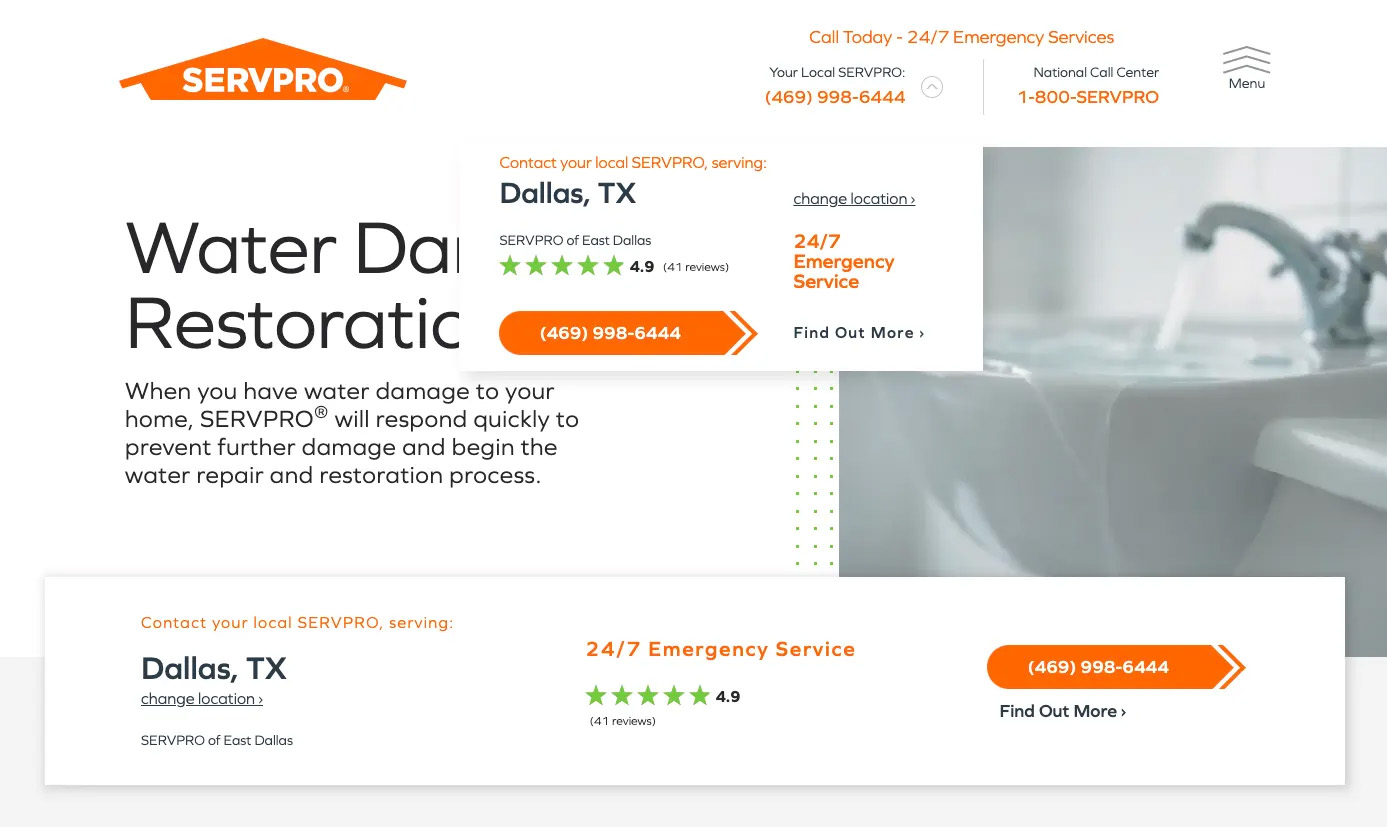
Intelligent local routing system The site's most technically sophisticated feature was also its most strategically essential: an IP-based location detection system that automatically identifies the user's nearest franchise and surfaces that location's phone number, address, and ratings prominently in the header. A ZIP code input allows manual override. This system appears not just in the header but at key decision points throughout the experience — ensuring that no matter where a user is in the site, local contact information is never more than a glance away.

Service architecture for 23 categories Designed a content and navigation system that organized 23 cleaning and restoration services into a hierarchy users could navigate intuitively under stress — without requiring them to understand SERVPRO's internal service structure. Each service page was architected to answer the same set of urgent user questions: Is this the right service for my situation? How quickly can you help? Who do I call?

Visual design system Developed a full UI design direction — visual hierarchy, component design, typography, color, and imagery — built to simultaneously communicate national brand authority and local approachability. The design system was documented for handoff to both the agency partner and the development team, ensuring consistent execution across the full site without requiring real-time creative direction for every component.

SERVPRO water damage restoration service page with local franchise contact information
05

Organizational Impact

An enterprise site that works the way the business works.

Multi-team delivery at enterprise scale Successfully directed creative across three separate teams — SERVPRO internal stakeholders, an external agency partner managing content, and a development team handling technical build — delivering a unified, coherent product from a multi-party production process. The upfront alignment framework prevented the fragmentation that typically slows or derails complex multi-team engagements.

1,900 locations, one coherent experience The finished site serves all 1,900+ SERVPRO franchise locations through a single, intelligently routed digital experience — national brand consistency with automatically localized contact and service information for every user, regardless of where they arrive from.

23 services, zero confusion All 23 cleaning and restoration service categories are presented within an IA that users can navigate under stress, without training, in an emergency. The architecture removed the cognitive load of parsing a complex service catalog from people who are already overwhelmed.

The strategic result SERVPRO left the engagement with a website that functions as genuine business infrastructure — not a brochure, but an operational system that routes distressed users to local help, presents a credible national brand, and scales cleanly across 1,900 franchise locations without breaking down at the edges.